Building the Physical AI & Robotics Narrative, from Story to Evaluation
Positioning programmable FPGA technology at the center of intelligent machines, then turning that story into webinar registrations and distributor engagement.
IMPACT AT A GLANCE
340 webinar registrations from ~1.08M paid LinkedIn + YouTube impressions
~5M distributor impressions (DigiKey + Mouser)
16K+ DigiKey clicks · 57.9K Mouser email reach
36 Physical AI assets · 969K+ impressions · 6.9% blended CTR, 67K+ clicks
Challenge: Position FPGAs inside the fast-growing Physical AI and robotics conversation, not just as component specs.
My role: Built Altera’s Physical AI narrative, ran paid video campaigns for Physical AI webinars, and led co-marketing programs with DigiKey and Mouser.
Why it mattered: Turned a technical story into identifiable demand (registrations routed to CRM) and took it into the channels where engineers evaluate and buy.
The Business Challenge
As AI moves from the cloud into the physical world, the conversation is dominated by GPUs and AI models. Yet robots, autonomous machines, smart factories, and vision systems need more than inference performance. They must sense, process, decide, act, and adapt in real time.
FPGAs deliver exactly what intelligent machines need: deterministic processing, low-latency inference, sensor connectivity, and programmability. But marketed on specifications alone, they risked being left out of one of the fastest-growing technology conversations.
The opportunity: Move the conversation from “FPGA features” to “what intelligent machines need,” then give engineers a clear path from that story to registration and evaluation.
Physical AI Webinar: Turning the Story into Registrations
Physical AI for Robotics: Building Deterministic Sensor-to-Actuator Systems
I promoted the webinar through paid LinkedIn and YouTube with a 31-second video built on the Sense → Process → Decide → Act narrative and a direct “Sign up” call to action to the registration page. View LinkedIn Post and watch the YouTube short.
Results (Sep 2026)
340 registrations · ~1.08M combined impressions
YouTube: 1,026,181 impressions · 220,368 views
LinkedIn: 54,825 impressions · 893 clicks · 1.63% CTR · 1,047 engagements
Why it matters: The same framework that drove content engagement also drove sign-ups, turning anonymous viewers into identifiable contacts routed to CRM for nurture.
Partner & Distributor Activation: Taking the Story to Where Engineers Buy
Scaling the Physical AI story through DigiKey and Mouser
Engineers typically evaluate and buy development hardware through distributors. I extended the Physical AI strategy into DigiKey and Mouser with co-marketing programs combining robotics applications, technical content, reference designs, email, programmatic media, and Agilex® 5 development kits, creating an engineering evaluation journey rather than product advertising.
Results
2.48M+ DigiKey impressions (Q2 2026) · 16K+ clicks
2.5M+ Mouser programmatic impressions · 57.9K email reach
From Awareness to Evaluation
Physical AI Story → Robotics Use Case → Technical Content → Reference Design → Agilex® Dev Kit → Evaluation
What can I build? → Application story
How can I build it? → Architecture + reference design
What platform can I use? → Development kit
How do I start? → Technical resources + distributor purchase
See the live programs: DigiKey: FPGAs for Robotics · Mouser: Altera Robotics Solutions Stack
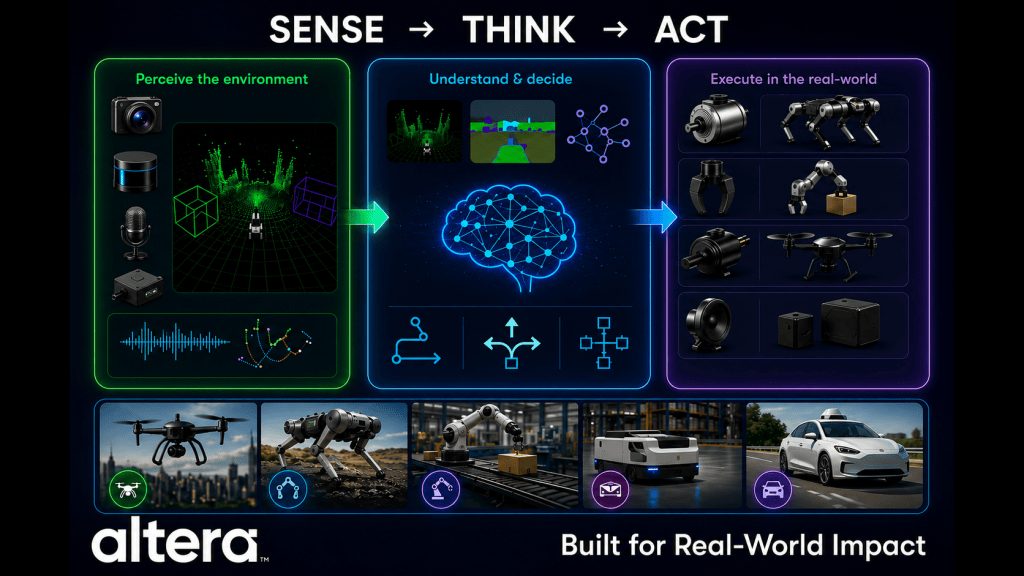
The Narrative Framework: Sense → Process → Decide → Act → Adapt Every piece of content, campaign, and partner program was built on one framework: what intelligent machines must do, linked to an FPGA capability at each step.
01. Sense
Vision & Sensor Connectivity
Cameras, LiDAR, radar, and sensors capture the data machines use to understand their environment.
02. Process
Real-Time FPGA Computing
FPGAs process high-bandwidth data in real time, close to where it’s generated.
03. Decide
Edge AI & Inference
Low-latency inference turns sensor data into actionable intelligence.
04. Act
Deterministic Control
Deterministic control delivers predictable, precise response.
05. Adapt
Programmable Architecture
Programmability lets systems evolve as sensors, AI models, and requirements change.
The framework also shaped the Physical AI web experience concept.
FROM TECHNICAL PROOF TO AUDIENCE-READY AI STORIES
Selected narratives from the 36-asset program, translating architecture, latency, sensor connectivity, and software into stories about workloads and customer value.
01 – Define the Physical AI opportunity
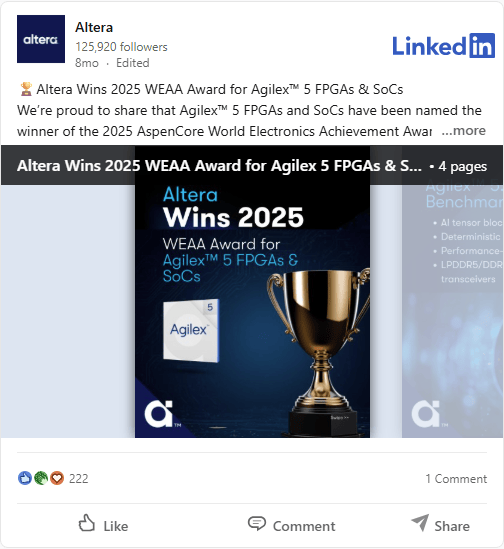
539K impressions | 54.7K clicks | ~10.1% CTR
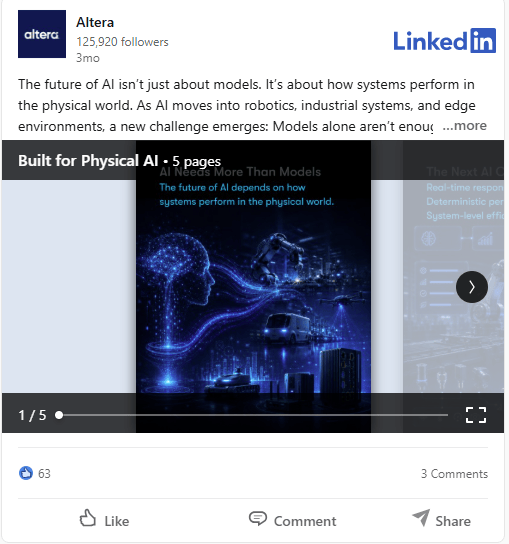
74.9K impressions | 6.7K clicks | 8.97% CTR
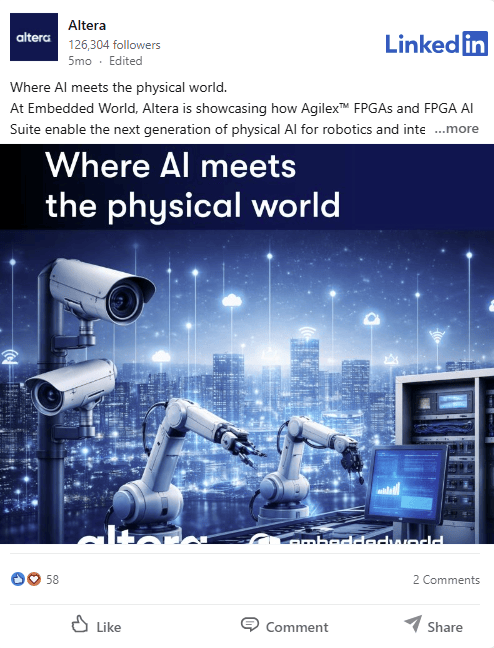
2.8K impressions | 47 clicks
02 – Translate technical proof into workload value
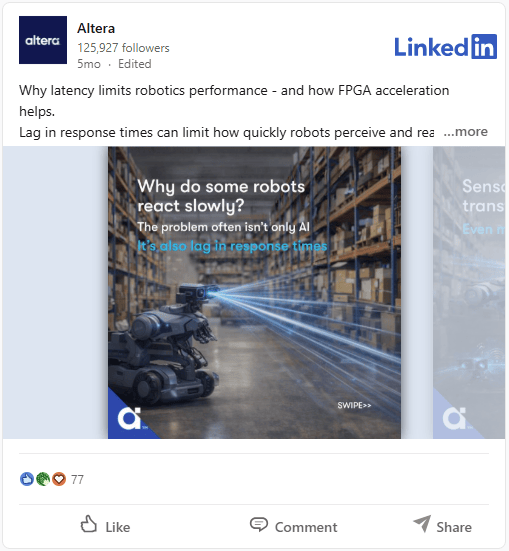
Customer challenge → Workload requirement → Technical capability → Customer value
41.0K impressions | 2.6K clicks | 6.34% CTR
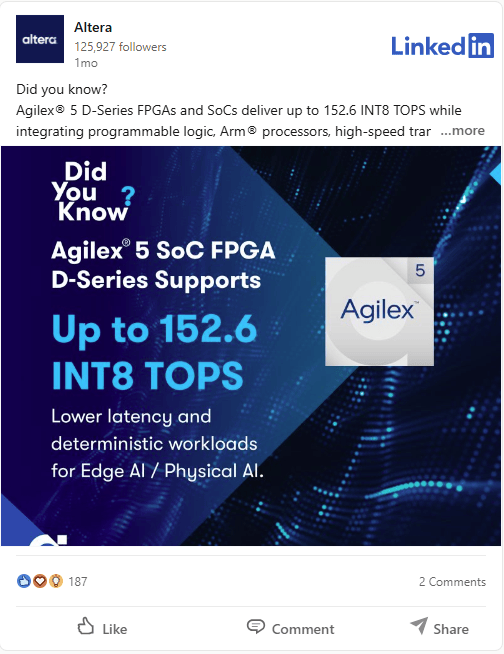
43.1K impressions | 1.6K clicks
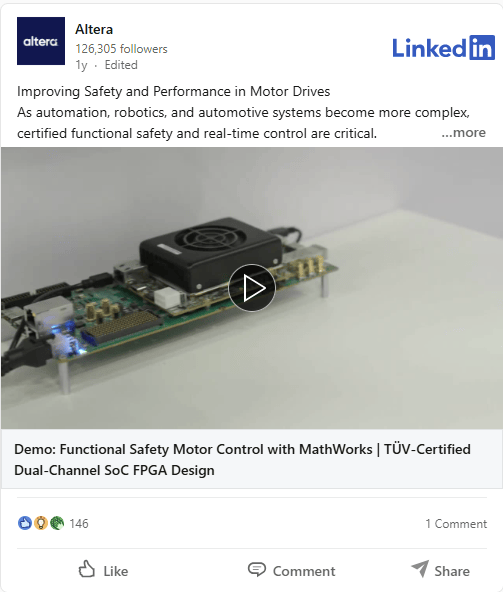
11.3K impressions | 474 clicks | 4.2% CTR
03 – Connect the broader AI system
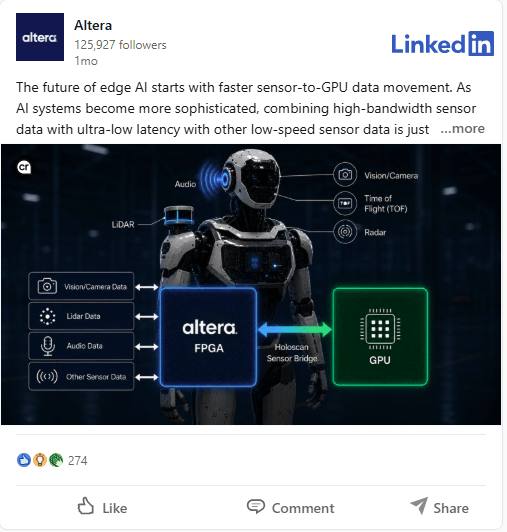
29.3K impressions | 869 clicks
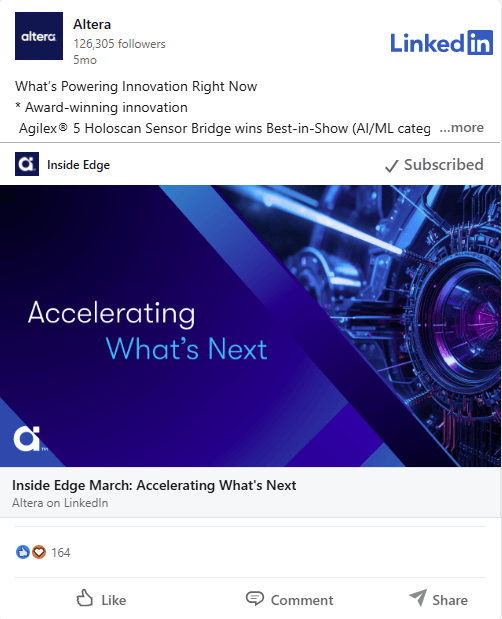
47.7K impressions | 1.2K clicks
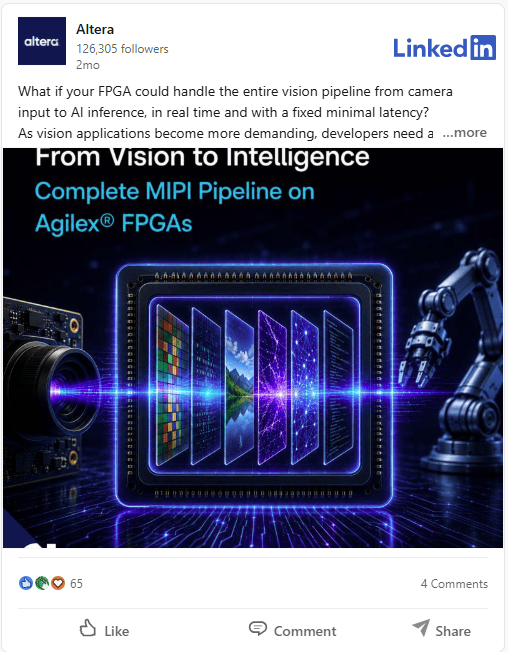
4.2K impressions | 121 clicks | 2.9% CTR
My Role
Narrative Strategy: Built the Physical AI narrative and the Sense → Process → Decide → Act → Adapt framework used across content, campaigns, events, and partners.
Paid Video & Webinar Promotion: Built and ran paid LinkedIn and YouTube video campaigns that drove webinar registrations.
Distributor Co-Marketing: Led Physical AI programs with DigiKey and Mouser, combining reference designs, dev kits, technical content, email, and programmatic media.
Workload & Application Storytelling: Linked FPGA capabilities to robotics, machine vision, sensor fusion, motor control, edge AI, and autonomous systems.
Content & Creative: Built messaging frameworks and creative for 36 Physical AI assets.
Performance Optimization: Used impressions, clicks, CTR, and registrations to identify which stories resonated and refine the next wave.
What Performance Revealed
Physical AI worked as an umbrella narrative.
AI, robotics, vision, sensing, and control became more coherent when framed around what intelligent machines need.
One narrative can drive both engagement and conversion.
The framework behind the content also powered a 31-second video that drove 340 webinar registrations.
Workload stories made differentiation clear.
Latency, determinism, and sensor bandwidth were easier to understand as engineering problems than as specifications. The strongest stories answered three questions: What’s the workload challenge? What capability addresses it? Why does it matter to the system?
FPGAs win by complementing GPUs, not competing with them.
The sensor-to-AI pipeline story gave FPGAs a clear role inside the broader AI system.
Distributors extend the story into evaluation.
DigiKey and Mouser carried the narrative into reference designs, dev kits, and the point of purchase.
Measurement should be built in from day one.
Distributor programs generated strong engagement, but revenue couldn’t be attributed to specific campaigns. Next time, I’d set up tracked links and SKU-level reporting with partners before launch.
Outcome
Turned Physical AI from a campaign theme into a full demand journey: 36 assets reaching 969K+ impressions at 6.9% CTR, a paid video campaign that drove 340 webinar registrations, and DigiKey and Mouser programs that delivered ~5M impressions and 16K+ clicks toward reference designs and Agilex® 5 development kits.
My approach to technical marketing:
Start with the workload. Understand the technical proof. Translate it into a story the audience can use, and give them a clear next step.

